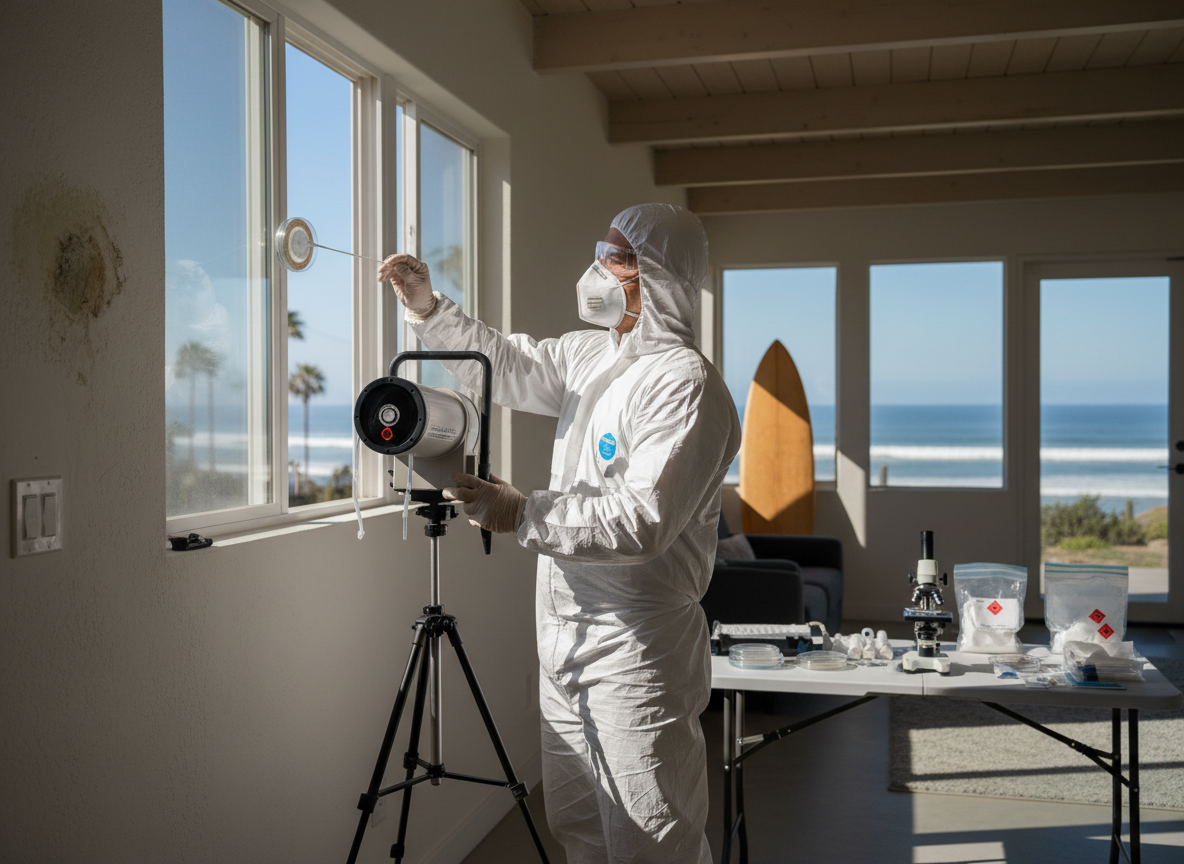
Mold spore testing in Solana Beach requires accounting for the mild coastal Mediterranean climate where ocean breezes keep daytime temperatures moderate yet create persistent humidity pockets inside older stucco and wood-frame homes in neighborhoods like Lomas Santa Fe and Solana Highlands. Technicians collect air samples from multiple rooms plus surface swabs from areas prone to condensation such as bathrooms and crawl spaces near the San Elijo Lagoon. Results distinguish between outdoor baseline spores common along the Solana Beach Coastal Rail Trail and indoor amplification that signals leaks or poor ventilation.
Homes built before 1980 in Downtown Solana Beach often feature single-pane windows and minimal insulation that allow salt-laden air to drive moisture into wall cavities. Spore testing protocols include outdoor control samples taken at Fletcher Cove Park to compare against interior readings, revealing whether elevated counts of Aspergillus or Penicillium originate from local conditions rather than a single plumbing failure. This data guides targeted remediation without unnecessary demolition in tight coastal lots.
Testing also covers post-remediation verification to confirm clearance levels before reconstruction, especially important after winter rains increase groundwater seepage near the lagoon. Samples are sent to accredited labs for genus-level identification and spore counts, giving homeowners in Encinitas and Del Mar comparable benchmarks when properties straddle city lines. Documentation includes chain-of-custody forms and site sketches marking every collection point.
Technician insight
In Solana Beach, the thing that catches most people out with mold spore testing is assuming the mild ocean climate prevents hidden growth; older homes in Solana Highlands trap moisture behind stucco because salt air slows drying even when outdoor readings at Fletcher Cove Park look low.
Hidden Spores in Lomas Santa Fe Residence
A homeowner noticed musty odors after heavy coastal fog but no visible stains. Testing revealed elevated Cladosporium counts inside wall cavities near the San Elijo Lagoon side of the property. Samples confirmed indoor amplification beyond outdoor baselines collected at nearby Fletcher Cove Park. Clearance sampling after targeted drying confirmed levels returned to normal.
How it works
- 1
Initial Site Assessment
Walk through the property noting moisture sources tied to ocean air infiltration in Lomas Santa Fe homes.
- 2
Sample Collection
Gather air and surface samples from affected and control areas, including outdoor references near Fletcher Cove Park.
- 3
Laboratory Analysis
Submit samples for spore identification and quantification to determine indoor amplification versus regional baselines.
- 4
Report and Recommendations
Deliver findings with maps and next-step guidance specific to Solana Beach construction types.
Pricing
Cost depends on square footage, number of samples, and whether post-remediation clearance is required.