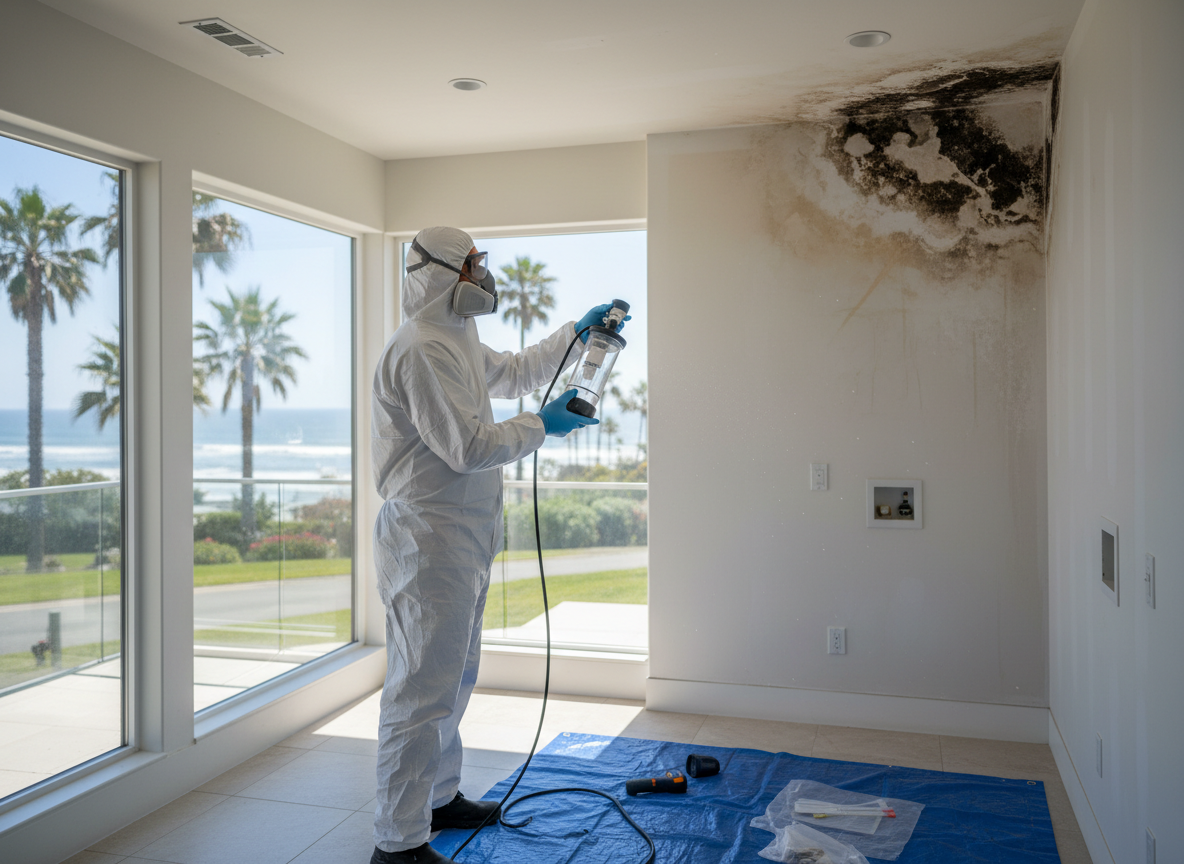
Solana Beach homes built before the 1990s in areas like Lomas Santa Fe and Solana Highlands often feature older HVAC ductwork and crawl spaces that trap moisture from the mild Mediterranean climate and ocean breezes. When testing for mold near me, technicians must check behind stucco walls and under raised foundations where salt air accelerates condensation. Air sampling and surface swabs are taken at multiple points to map hidden growth that standard visual checks miss, especially near the San Elijo Lagoon where seasonal fog keeps relative humidity elevated year-round.
Testing protocols here differ from inland San Diego jobs because coastal properties along the Solana Beach Coastal Rail Trail and near Fletcher Cove Park experience constant salt-laden air that corrodes metal vents and promotes mold on drywall seams. We pull samples from attics, bathrooms, and laundry rooms where poor ventilation meets ocean moisture. Results guide targeted remediation instead of whole-house guesses, preventing unnecessary disruption in tightly spaced neighborhoods like Downtown Solana Beach.
Edge cases include post-remodel homes where new insulation traps moisture against older plaster, or properties near Del Mar and Carlsbad that share similar coastal exposure. We document spore counts against outdoor baselines taken the same day to avoid false positives from regional pollen. Homeowners receive a written map of findings with photos and recommendations tied directly to their property's construction type and location.
Technician insight
In Solana Beach, the thing that catches most people out with Mold testing near me is assuming ocean breezes keep everything dry. Homes near Fletcher Cove Park and the Coastal Rail Trail actually hold more hidden moisture in older stucco and ductwork because salt air slows drying, so we always test HVAC returns first.
Hidden growth in Lomas Santa Fe crawl space
A homeowner noticed musty smells after winter fog. We found elevated spores in the crawl space under a 1970s home near Lomas Santa Fe Drive where ocean moisture had condensed on older insulation. Targeted air and surface samples confirmed the source without disturbing finished areas, allowing focused drying instead of broad remediation.
How it works
- 1
Initial Assessment
Review property history and visible moisture sources in Solana Beach homes.
- 2
On-Site Sampling
Collect air and surface samples from key zones including crawl spaces and attics.
- 3
Laboratory Analysis
Send samples for spore identification and comparison to outdoor controls.
- 4
Detailed Report
Deliver findings with location-specific recommendations and photos.
Pricing
Cost depends on square footage, number of samples, and whether crawl space or attic access is required.