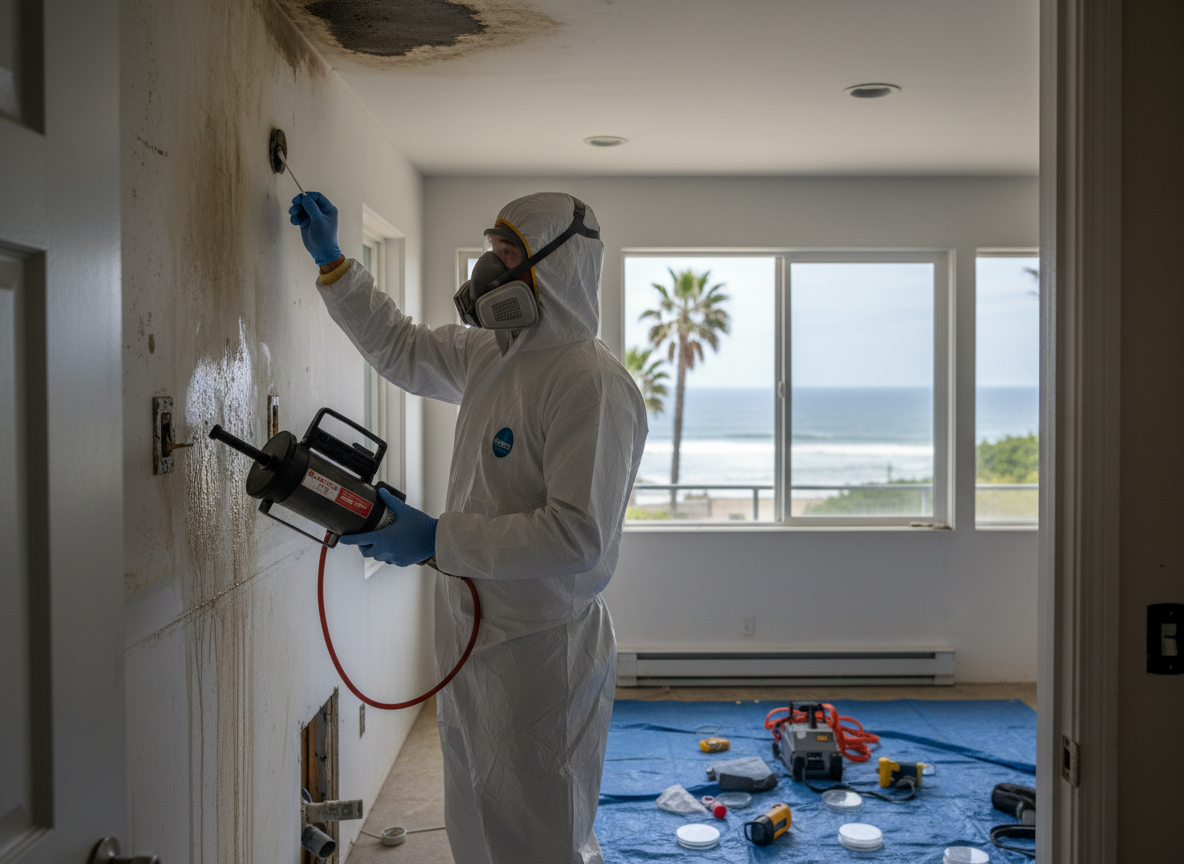
Mold testing in Solana Beach requires attention to the mild coastal Mediterranean climate where ocean moisture lingers in crawl spaces and wall cavities long after visible leaks dry. Homes in Lomas Santa Fe and Solana Highlands often feature older stucco and wood-frame construction from the 1960s onward that traps humidity from the nearby San Elijo Lagoon and Fletcher Cove Park. Air sampling and surface swabs must target these microclimates because standard visual checks miss growth behind drywall or under flooring near the Solana Beach Coastal Rail Trail corridor.
Testing protocols here differ from inland San Diego County jobs because salt air accelerates corrosion on HVAC components and encourages condensation on cooler interior surfaces during evening marine layers. Technicians working from our base at 911 Lomas Santa Fe Dr routinely check attics and subfloors in Downtown Solana Beach properties where roof penetrations around skylights allow persistent dampness. Edge cases include false negatives from over-ventilation during sampling and cross-contamination risks when properties sit close to Encinitas or Del Mar boundaries with shared drainage patterns.
Results guide targeted remediation rather than blanket removal, especially in Carlsbad-adjacent homes where terrain slopes create hidden water intrusion points. Documentation includes moisture meter readings and thermal imaging to satisfy local building department expectations without unnecessary demolition. Homeowners in these neighborhoods benefit from testing before real estate transactions or after winter rains that push moisture through aged foundations common along the coastal rail trail.
Technician insight
In Solana Beach the thing that catches most people out with Mold Testing is how the constant ocean influence keeps humidity trapped in the older stucco homes along Lomas Santa Fe and near the lagoon even when the rest of the house feels dry. Homeowners often assume a single dehumidifier fixes everything but the marine layer keeps feeding moisture into wall cavities we find during testing.
Hidden Moisture Behind Kitchen Cabinets
A homeowner in Solana Highlands noticed musty odors after heavy winter rains. Testing revealed elevated moisture levels behind cabinets where ocean humidity had entered through an aging window seal. Samples confirmed mold growth in the wall cavity. We documented the extent and provided a targeted remediation plan that avoided full kitchen demolition.
How it works
- 1
Initial Consultation
Discuss property history, recent leaks, and visible signs while noting location relative to Lomas Santa Fe Drive or the lagoon.
- 2
On-Site Inspection
Perform moisture mapping and air sampling in affected zones including crawl spaces and attics typical of Solana Beach housing.
- 3
Laboratory Analysis
Send samples for identification of mold types influenced by coastal humidity and return results with clear explanations.
- 4
Report and Recommendations
Deliver findings with prioritized next steps that respect the property's age and proximity to ocean-driven moisture sources.
Pricing
Pricing varies by square footage, number of samples, and access challenges common in coastal Solana Beach homes. Upfront quotes provided after initial consultation.