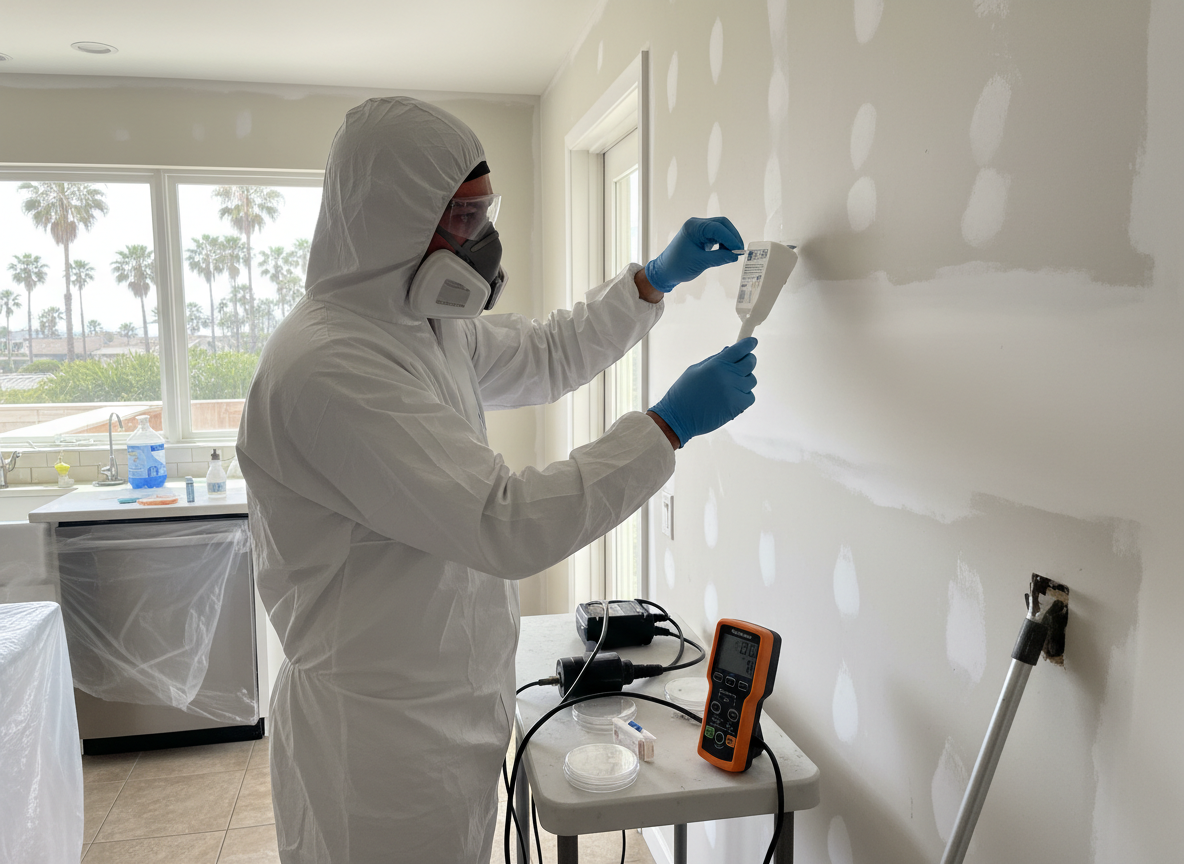
Post remediation mold testing in Solana Beach requires careful sampling after removal work because the mild coastal Mediterranean climate keeps humidity levels elevated year round. Homes in Lomas Santa Fe and Solana Highlands often have older wood framing and crawl spaces that trap moisture from ocean air and occasional heavy winter rains. Technicians collect air samples from multiple rooms plus surface swabs on drywall and wood, then send them to an independent lab for spore count comparison against outdoor baselines. This step prevents callbacks when ocean influence or proximity to the San Elijo Lagoon allows hidden moisture to remain.
Edge cases appear frequently near Fletcher Cove Park and along the Solana Beach Coastal Rail Trail where salt air accelerates corrosion on HVAC components and window frames. Testing must include supply and return ducts because even small gaps can recirculate spores after remediation. San Diego County building codes require documentation of clearance before any reconstruction can begin, so reports include chain-of-custody forms and photos of every sample location. Homeowners in Encinitas or Del Mar who skip this step often face repeated issues when coastal fog keeps interior humidity above 60 percent for weeks.
Warning signs that testing is incomplete include musty odors returning within days or visible condensation on north-facing walls. Proper protocol calls for waiting 48 to 72 hours after dehumidification ends before sampling so that any remaining moisture has time to equalize. Results are compared against outdoor controls taken the same day to account for the natural marine environment rather than relying on generic thresholds.
Clearance criteria focus on spore types and concentrations rather than a simple zero reading, because coastal air always carries some outdoor mold. A written report details each sample result and notes any conditions that could allow regrowth, such as poor grading near the address at 911 Lomas Santa Fe Dr.
Technician insight
In Solana Beach, the thing that catches most people out with post remediation mold testing is how the steady ocean influence from the San Elijo Lagoon keeps crawl spaces and wall cavities damp long after dehumidifiers are removed, especially in 1970s and 1980s homes along Lomas Santa Fe Dr.
Clearance Testing After Water Intrusion Near Downtown
A property in Downtown Solana Beach showed recurring musty smells after initial remediation. Sampling revealed elevated Aspergillus spores inside wall cavities connected to the rail trail side of the house. Additional drying and a second round of samples produced clearance levels matching outdoor air from the coastal zone.
How it works
- 1
Site Walkthrough
Technician inspects all previously affected areas in the Solana Beach home and notes any visible moisture or new staining.
- 2
Air And Surface Sampling
Collect indoor air cassettes and swab samples from walls, ceilings, and HVAC registers while taking an outdoor control sample for comparison.
- 3
Laboratory Analysis
Samples are sent to an accredited lab for spore identification and concentration counts, with results typically returned in 24 to 48 hours.
- 4
Clearance Report
Provide a written report with photos, lab data, and any recommendations for ongoing moisture control suited to the coastal climate.
Pricing
Cost depends on square footage, number of samples required, and whether HVAC testing is needed.