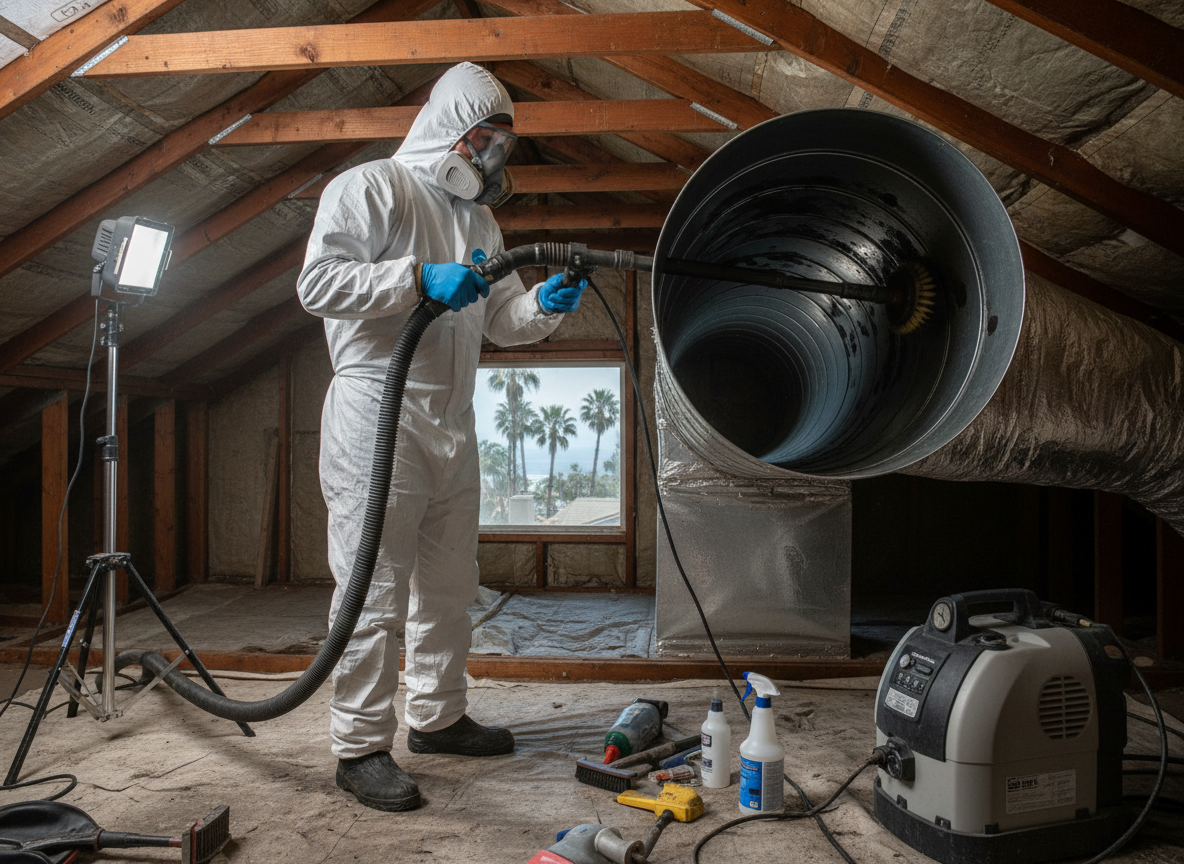
Ventilation mold remediation in Solana Beach addresses growth inside ductwork, registers, and attic fans where the mild Mediterranean climate meets constant ocean moisture. Homes in Lomas Santa Fe and Solana Highlands often feature older forced-air systems installed before current sealing standards, allowing condensation to form along metal runs that pass through unconditioned attics. Technicians must isolate each branch run, remove contaminated insulation, and treat surfaces without spreading spores into living spaces that sit close to the San Elijo Lagoon wetlands.
Coastal fog rolling in from Fletcher Cove Park and along the Solana Beach Coastal Rail Trail keeps relative humidity elevated year-round, so simple surface cleaning rarely solves the problem. Remediation requires negative-air machines tied to exterior exhaust points, HEPA-filtered vacuuming of every linear foot of duct, and antimicrobial application rated for HVAC use. In Downtown Solana Beach properties near the rail line, technicians also check for water intrusion at roof penetrations where salt air accelerates corrosion of flexible connectors.
Nearby Encinitas, Del Mar, and Carlsbad homes share similar construction, yet Solana Beach jobs frequently involve smaller lot sizes that limit equipment placement. Crews stage containment from driveways while running temporary dehumidification to keep indoor levels below 50 percent during the multi-day drying phase. Final clearance includes borescope inspection of every accessible elbow and register to confirm no residual growth remains before the system is returned to service.
Technician insight
In Solana Beach the thing that catches most people out with ventilation mold remediation is how the constant ocean breeze through the San Elijo Lagoon keeps attic humidity high even on sunny days, so homeowners who only clean visible registers miss the condensation that forms inside the main trunk line running through Lomas Santa Fe homes built in the 1970s.
Hidden Growth in Solana Highlands Attic Runs
A homeowner noticed musty air only when the furnace kicked on. Inspection showed heavy growth on the main supply trunk where it crossed the uninsulated attic space cooled by nightly coastal fog. Crews isolated the system, removed the contaminated section, treated the remaining metal, and restored airflow after three days of drying.
How it works
- 1
Detailed System Mapping
Technicians trace every supply and return run from the air handler through attics and crawlspaces in Solana Beach homes, noting condensation points created by proximity to the lagoon.
- 2
Containment and Isolation
Plastic barriers and negative-air machines are set up at each register and the main unit to prevent spore migration into living areas during removal.
- 3
Source Removal and Cleaning
Contaminated insulation and flexible duct sections are cut out, followed by HEPA vacuuming and antimicrobial treatment of rigid metal runs.
- 4
Drying and Verification
Dehumidifiers run until moisture readings stabilize, then borescope and air sampling confirm clearance before the system restarts.
Pricing
Cost depends on number of runs, accessibility in older Solana Beach attics, and whether insulation replacement is required; upfront quotes provided on site.